News & Insights
Four Years of Independent Evaluation of Sardinia's 2014–2020 ERDF Regional Operational Programme
SEP 2026
Publishing 29 June 2026
The fourth annual Conference of the Smart Specialisation Community of Practice (S3 CoP), "Regions driving European Innovation and Competitiveness", took place on 23–24 June at Autoworld in Brussels, bringing together around 450 policymakers, practitioners, cluster organisations and business and innovation intermediaries from across Europe. t33 guided the workshops of the four S3 Learning Communities, which formed a central strand of the second day's programme.
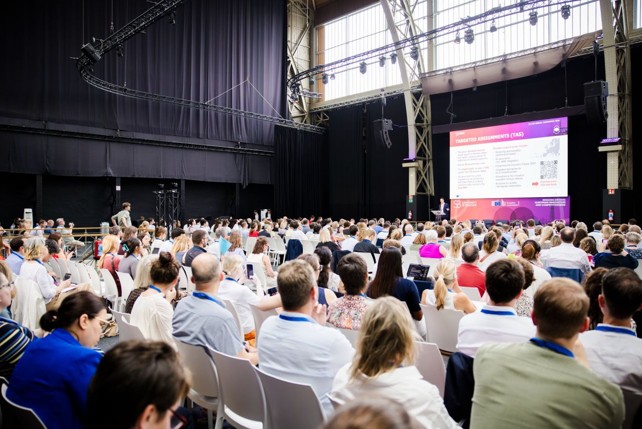
Day 1 opened with welcome remarks from Nicola de Michelis (DG REGIO), followed by a video keynote from Raffaele Fitto, Executive Vice-President for Cohesion and Reforms, on the strategic role of Smart Specialisation in Europe's competitiveness, sovereignty and cohesion agenda. De Michelis then set the scene on why Smart Specialisation matters in the evolving EU policy context, before a keynote from Verkor on battery leadership and the rise of Hauts-de-France as a European battery hub. Two panel discussions followed, on competitiveness and strategic sovereignty, and on operationalising S3 across governance, policy mixes, directionality and interregional cooperation, with speakers from the Commission, the Committee of the Regions, Ireland, Galicia, Sweden and Poland. The afternoon featured regional S3 pitches from La Réunion, Berlin, North-East Romania, North Denmark and the Northern Netherlands, followed by three parallel breakout sessions on multi-level governance, delivery and performance, and interregional cooperation towards EU value chains.
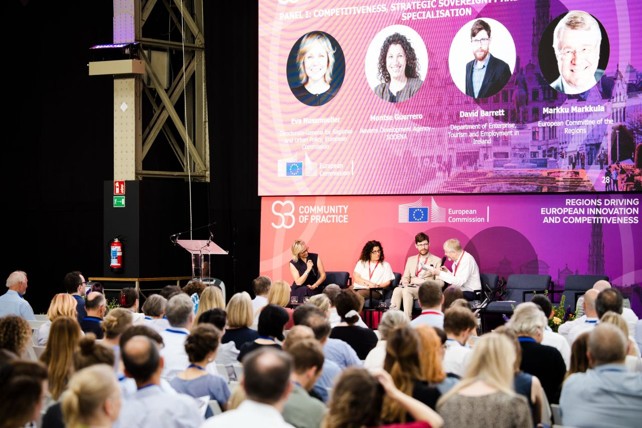
Day 2 ran across three parallel tracks: the Annual Meeting of S3 Thematic Platforms and Partnerships, interactive Partnership Fora on industrial modernisation and energy, agri-food, and the sustainable blue economy, and the Meeting of the S3 Learning Communities (S3LCs).
The S3 Learning Communities at work
The S3LCs are managed and coordinated by t33 in collaboration with Ecorys, GAC and the European Clusters Alliance, within a wider consortium led by Prognos AG and also involving EURADA, EBAN, Tipik and iO. Participation in the workshops was active: approximately 70 representatives of regions and Member States divided across the four sessions, each facilitated by t33 community coordinators – S3 Directionality (Lorenzo Palego, Anda Iacob), S3 Governance and Performance (Clarissa Amichetti, Lorenza Odoardi), S3 Internationalisation and Interregional Cooperation (Laura Varisco, Antonio Novo), and S3 and Competitiveness (Giovanni Familiari, Alessandro Fratini).
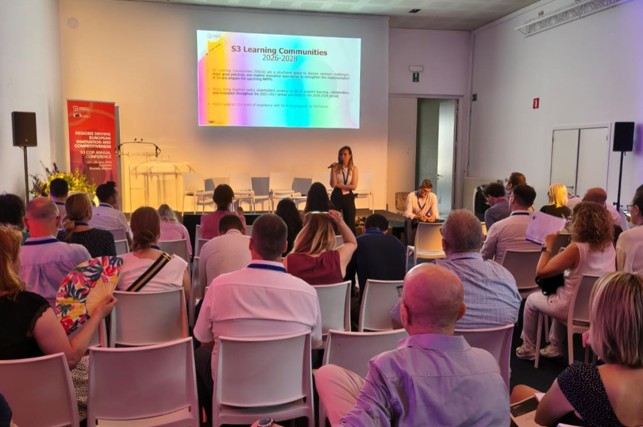
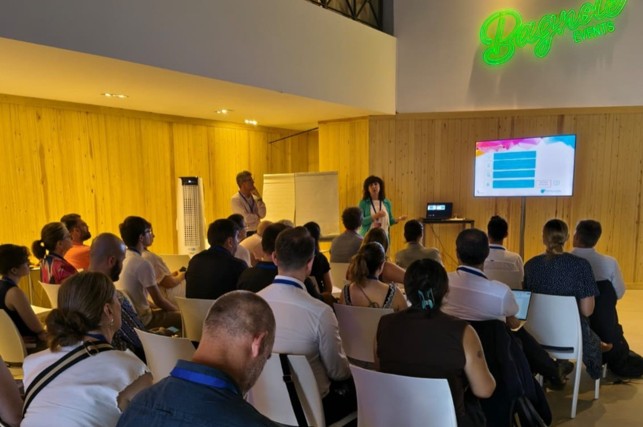
The day opened with a recap of the kick-off webinar held by the four communities in April, where participants had prioritised the topics to guide their work through 2026. In an initial plenary, the S3 CoP experts summarised the progress made so far. The parallel workshops focused on analysis and discussion on the current 2021–27 programming period, and on solutions and perspectives for 2028–34. The community coordinators prepared groupwork exercises on selected themes and engaged participants in intensive discussion, sharing practices and working through current and upcoming challenges.
Looking to the next programming period
The timing gave the discussions a sharp edge. The framework of the future National and Regional Partnership Plans (NRPP) is still under definition, and during the conference the Commission reaffirmed the central role of Smart Specialisation in the delivery of research and innovation. Against this background, participants in the S3LCs concentrated on the scenarios taking shape, among them: the future relationship between regions, national authorities and the EU level within the next architecture of Cohesion policy; how best to select R&I priorities so that they contribute to regional and European competitiveness; and how to work within the performance-based framework being designed for the NRPP.
These questions ran through the wider conference as well. A clear shift emerged in the debate: after more than a decade of practice, S3 is moving into a new stage from a position of strength, high regional ownership and a substantial body of accumulated learning. Competitiveness, it was argued, starts in places, with instruments such as the Competitiveness Compass and the European Competitiveness Fund expected to build on the strengths of regions, clusters and innovation ecosystems rather than selecting winners from the top down. Strategic resilience was tied to the capacity of regions to develop and connect specialised capabilities within broader European value chains. Industrial transformation – in batteries, clean technologies, advanced manufacturing, digital and defence-related innovation – was seen to depend on ecosystems of firms, research organisations, public authorities and clusters working across administrative boundaries. Scale was a further concern, with stronger interregional collaboration, interlinked investment portfolios and more embedded private capital seen as necessary to turn research strength into globally competitive value chains. Coordination itself was framed as a competitiveness issue, with the future NRPPs positioned as the vehicle for aligning EU, national and regional priorities, and S3 providing the strategic backbone.
As part of the programme, the S3 CoP also presented the support available to Member States and regions, ranging from the new S3 CoP Observatory to targeted expert support, partnership services and community-building activities.
Continuing the exchange
Over two days, the conference confirmed the sustained interest of Cohesion policy officials in Smart Specialisation. It surfaced open questions and uncertainties about the period ahead and, through the S3 Learning Communities, offered a structured setting in which to address them by exchanging information and sharing practices.
The S3LCs will resume their webinars after the summer. Further information on the conference is available on the S3 CoP Conference 2026 webpage. The next S3 CoP Conference has already been announced and will take place in Düsseldorf, Germany, in April 2027.
SEP 2026
JUL 2026
JUN 2026
MAR 2026
FEB 2026
DEC 2025