News & Insights
T33 at the 2026 RSA Annual Conference
OCT 2026
Publishing 23 July 2026
Following the establishment of its Bucharest office in 2025, T33 has built a substantial body of work in Romania, spanning the full Cohesion Policy cycle – from the ex-ante design of financial instruments through mid-term, operational and ex-post evaluation to administrative capacity building and territorial cooperation. These mandates reach across the tiers of Romanian public administration – the Ministry of Investments and European Projects, the Ministry of Development, Public Works and Administration, the Ministry of Agriculture and Rural Development, the North-West and South-West Oltenia Regional Development Agencies as well as international partners such as EIB Advisory. They span both the 2014–2020 and 2021–2027 programming periods, increasingly informing the design of the post-2027 framework.
Throughout, T33 applies a consistent mixed-methods approach – desk research, indicator and context analysis, interviews, surveys, focus groups, case studies and expert panels – triangulating quantitative and qualitative evidence and structuring the analysis around an explicit intervention logic or theory of change, tailored to the questions of each assignment. Individual assignments then draw on more specialised techniques matched to the evidence needs of each contract, for instance: market feasibility analysis for financial instruments, systems-thinking-based theories of change for territorial governance, counterfactual and comparative analysis for rural development, and visual mapping for infrastructure cost-benefit assessment.
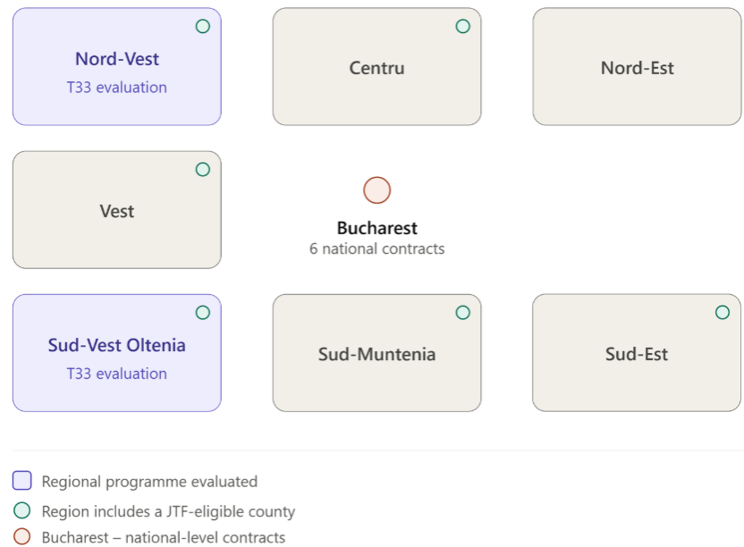
Schematic representation of T33's Romania portfolio by region; not to scale
Regional development policy
Evaluation of the ERDF North-West Regional Programme 2021–2027 (ongoing)
Commissioned in December 2024 by the North-West Regional Development Agency, in its capacity as Managing Authority, this contract covers the evaluation of the entire programme implementation over a 27-month period. T33 assesses effectiveness, efficiency, relevance, internal and external coherence and EU added value, alongside cross-cutting dimensions such as visibility, social cohesion and environmental sustainability. The assignment delivers eleven evaluation reports over the course of the contract, sequenced from the mid-term review and the Technical Assistance priority through to each specific objective of the programme. The service is led by Cristina Neacșu and Andrea Gramillano.
Mid-term evaluation of the South-West Oltenia Regional Programme 2021–2027 (concluded)
Between October 2024 and March 2025, T33 conducted the mid-term evaluation of the South-West Oltenia (Romania) Regional Programme 2021–2027, in compliance with Article 18 of Regulation (EU) 2021/1060. The evaluation assessed the coherence and relevance of the programmed and implemented actions and whether modifications were needed to address challenges emerging since the start of the period. Its findings supported a series of changes keeping the programme relevant to regional priorities and EU objectives. The service was led by Roxana Diaconu.
Advisory support for the ex-ante assessment of financial instruments addressing JTF and STEP priorities (concluded)
Commissioned by EIB Advisory in March 2025, this feasibility study supported Romania's Investment and Development Bank, in designing a financial instrument to increase financing in the counties targeted by the Just Transition Fund while also supporting investment and competitiveness in critical technologies under the STEP Regulation. It assessed demand and supply for an instrument targeting STEP priorities – such as biotechnology and semiconductors – across the six JTF-eligible counties. Deliverables included a market assessment, a proposal for the financial instrument, a draft product term sheet and a governance model. The study was carried out in consortium with EY and led by Giovanni Familiari.
Evaluation of the Partnership Agreement 2021–2027, Phase II, Lot 3 – Integrated Territorial Approach (ongoing)
Contracted in March 2026 by the Ministry of Investments and European Projects, this evaluation examines the functioning, effectiveness and governance of Romania's integrated territorial mechanisms – Integrated Territorial Investments, Sustainable Urban Development strategies and Community-Led Local Development – across both the 2014–2020 and 2021–2027 periods, together with up to nine ad-hoc evaluation reports on themes identified by the Managing Authority. The evaluation runs to December 2029, with the PA 20 evaluation expected by the first half of 2027, and is coordinated by Roxana Diaconu.
Territorial cooperation
Operational Evaluation of the Interreg VI-B NEXT Black Sea Basin Programme 2021–2027 (concluded)
Commissioned in October 2025 by the Ministry of Development, Public Works and Administration, this operational evaluation examined programme management and implementation, including communication, across an eligible area covering three EU Member States (Bulgaria, Greece, Romania), four candidate countries (Georgia, Moldova, Türkiye, Ukraine) and one non-EU country (Armenia). The evaluation generated evidence on the programme's efficiency, effectiveness, relevance and visibility, considering administrative and financial capacity, simplification measures and the continued relevance of the programme to regional needs. It delivered an Evaluation Report and a Communication Evaluation Report. The evaluation was coordinated by Rebeca Nistor.
Environment and rural policy
Evaluation of the Partnership Agreement 2021-2027 Phase I, Lot 2. Policy Objective 2 (a greener, low-carbon Europe) and the Just Transition Specific Objective - "Progress towards reducing CO2 emissions" (concluded)
Carried out under the evaluation of Romania's Partnership Agreement 2021–2027 for the Ministry of Investments and European Projects, this evaluation analysed the extent to which programmed and implemented interventions contribute to decarbonisation, climate change adaptation, the protection of natural capital, the modernisation of environmental infrastructure and greater economic and social resilience. It covered energy, climate change and risk management, water and wastewater infrastructure, the circular economy, biodiversity and blue-green infrastructure, urban mobility, air quality, contaminated sites, and fisheries and aquaculture. The evaluation was coordinated by Cristina Neacșu.
Ex-post evaluation of water and wastewater infrastructure – POIM 2014–2020 (ongoing)
Carried out under the evaluation of the Partnership Agreement 2021–2027, this contract addresses the ex-post analysis of investments in water and wastewater infrastructure financed under POIM 2014–2020 (Priority Axis 3, Specific Objective 3.2). The evaluation identifies the impact of the interventions and draws lessons learned that are directly relevant to the projects phased into the 2021–2027 period. Evaluation questions address the extension of population connection to public networks, enabling conditions for connection, the affordability principle, the technical capacity of beneficiaries to maintain the infrastructure and the cost-benefit ratio of the investments. The evaluation is coordinated by Andrea Gramillano.
Ex-post evaluation of the Romanian National Rural Development Programme 2014-2020, including the 2021-2022 transition period (ongoing)
The Romanian Ministry of Agriculture and Rural Development has contracted T33 to carry out the ex-post evaluation of the National Rural Development Programme (NRDP) 2014–2020, including the 2021–2022 transition period. As Romania's main rural development instrument, the NRDP channels European Agricultural Fund for Rural Development (EAFRD) funding towards agricultural competitiveness, the sustainable management of natural resources and climate action, stronger rural economies and balanced territorial development. Covering the entire country, the evaluation assesses the extent to which these interventions have met their objectives and generates evidence to inform future rural development policy. The evaluation is coordinated by Rebeca Nistor.
Sectoral policy
Evaluation of the PoAT 2021-2027 contribution to the implementation of the administrative capacity building measures included in the National Roadmap (concluded)
The Ministry of Investments and European Projects of Romania has contracted T33 to carry out the evaluation of the contribution of the Operational Programme Technical Assistance (PoAT) 2021–2027 to the implementation of administrative capacity building measures included in the National Roadmap. The general objective was to assess the relevance, coherence, effectiveness and efficiency of the resources allocated through PoAT 2021–2027 in supporting these measures, complemented by impact, sustainability and visibility criteria proposed by T33. Beyond assessing the level of achievement, it aimed to identify the key factors influencing successful or underperforming implementation, generate lessons learned and formulate practical recommendations to support evidence-based decision-making by the Managing Authority and other stakeholders, including for the design of future technical assistance interventions post-2027. The service was coordinated by Cristina Neacșu.
Evaluation of project preparation support for the development of technical and economic documentation within the PoAT 2014 - 2020, intended for the preparation of the project portfolio in strategic areas considered priority for the 2021-2027 programming period (concluded)
The Ministry of Investments and European Projects has contracted T33 to evaluate the support provided for developing technical and economic documentation under the PoAT 2014–2020, in line with the Evaluation Plan of PoAT 2021–2027. The evaluation focuses on interventions supporting the preparation of a mature project portfolio for 2021–2027, targeting strategic areas such as smart specialisation, urban regeneration and mobility, county-level road infrastructure, and tourism and leisure infrastructure. It generated conclusions, lessons learned and operational recommendations. The evaluation was coordinated by Roxana Diaconu.
What this means in practice
Delivering across regulatory frameworks, client types and thematic fields within a single national context is methodologically demanding, and it is also cumulative. Covering both programming periods and multiple tiers of administration, the portfolio allows insights from one assignment to sharpen the questions posed in another, while patterns that recur across evaluations carry greater evidentiary weight than the findings of any single contract. As the 2021–2027 period matures and post-2027 programming takes shape, this accumulated evidence positions T33 to support Romanian authorities not only in assessing what has been done, but in designing what comes next.
OCT 2026
SEP 2026
JUL 2026
JUN 2026
MAR 2026
FEB 2026